Reducing the Toxicity of Social Media

IMG_0208

Reducing the Toxicity of Social Media

Is it just me, or does anyone else feel that social media has become a toxic environment for communication? It seems to hold so much potential for good—yet the past few years has really brought out the nastiness and toxicity of much of our online communication through social media. Why do we feel so free to name, to insult, to assume worst intentions, to blame, to demean, and to unfriend? Why such a hostile, angry tone to so much of our discourse, especially for those of us who claim to follow Christ?

My dear brothers and sisters, take note of this: Everyone should be quick to listen, slow to speak and slow to become angry, 20 because human anger does not produce the righteousness that God desires (James 1:19, NIV)    

Perhaps James advice could be applied to social media. If I could paraphrase a bit: “Be quick to listen, really listen to each other, be slow to post (think first before hitting send), and slow to become angry.”

Let me offer a few suggestions as to how we might take first steps toward communicating civilly in an online environment.

Be quick to listen. 

The Proverbs repeatedly call us to listen carefully with the intent to truly understand. One particularly pertinent proverb: “To answer before listening—that is folly and shame” (Proverbs 18:10). Good advice for our online communication. Before labelling an individual, before naming them, before accusing them, before assuming their intentions, listen to them.

Stephen Covey speaks of “empathetic listening” as the highest form of listening. He describes it as “listening with the intent to understand, to get inside the other person’s frame of reference, seeking to understand them emotionally as well as intellectually” (7 Habits of Highly Effective People). Listening on this level is difficult in social media. We don’t have all the tools of communication available (body language, tone of voice, etc.) and it is easy to misread the intent or tone of a comment. 

How could we promote more empathetic listening? First by showing more grace and not assuming the worst intentions. Second, by asking questions to truly seek to understand. Not with an agenda, or an aggressive style which will not help. It should go without saying but it certainly means that you don’t attack, call names, become easily offended or angry, or become sarcastic and mean spirited.

I think James admonition to be quick to listen suggests something else as well. We should get outside our “echo chambers” of people just like ourselves and learn to listen to people with different backgrounds and life experiences. My life has been enriched by broad exposure to people from many places around the world and around the country. Civil conversation with those with different backgrounds, ideas and beliefs is a beneficial exercise worth the time and effort. I highly recommend it. I would hope that social media could provide such an environment—perhaps it can—but we must learn to be quick to listen.

Being quick to listen means being a person that seeks to learn, that seeks to understand, that takes the time to really understand where people are coming from and why they believe the things they do.

Being a “quick listener”—a good listener—will almost always open the door for you to share your opinions as well. It can lead to the opportunity to communicate, to encourage, to share your ideas and experiences, perhaps even to testify to what God has done for you. It is more likely to lead to an open door, than trying to shove your ideology and beliefs down the throats of others you’ve not taken the time to get to know.

Be slow to speak (to post, to respond).

Think through your words carefully before you post. Remember others will read what you are writing. Try to put yourselves in the shoes of your intended (and unintended) readers. How will this affect them? How will it impact them? Who might it offend? Can I reword it so that it doesn’t cause unnecessary offense? Can I reword it so it more graciously deals with those who might disagree? Can I reword it so that it more carefully expresses the ideas I wish to express? Have I done the necessary research to make sure what I am saying is actually true? If I am quoting, have I made sure that I am quoting accurately (giving the reference when possible so we can read the context)?

If you are sharing a post, have you checked to make sure that it is true? Is it from a trusted source? If it is from an ideologically driven source? If it is, does the bias overshadow the truth? The internet has opened a world where fantasy masquerades as truth, where misinformation often looks just like fact, and where we must evaluate sources to find the kernels of truth amidst bias. Where we must wade through opinion to find facts. Check your sources well, and if you aren’t sure—don’t share it.

One of the great errors of our day is that we tend to share information that feels true to us. Comedian Stephen Colbert called it “truthiness”—believing that something is true, because I feel it is true. If it speaks to our ideological bias we tend to accept it without perusing it carefully. Pause before you share and make sure that I’m not sharing it just because it “feels right”—make sure it is true. As believers we are called to a standard of truth. We may all, with the best of intentions, fail at points—but we should seek to only spread things that we know are true.When in doubt, there is no need to post.

I certainly think there is no reason why we cannot share opinions about politics or current events, though I have been hesitant to share for several reasons: 1) the toxicity of the environment, 2) the tendency for social media to be driven by extreme ideologies with little room for nuance or moderation, 3) my political views are much less important to me than my opportunity to enjoy interaction with family and friends (who do not all hold the same views—and will more likely be turned off than convinced by a constant barrage of ideologically driven posts from questionable sources), much less important than my ability to encourage and minister and pray for people, much less important than my testimony and witness. Besides that, I can’t think of one political post that has ever changed my opinion on an issue (though they do have a way of changing our opinion of one another). Sure, there is a place for sharing our views, even political, but can we do it in a civil way? Can we allow nuance, differences of opinion, and a civil tone to guide our discussions?

Before you post, perhaps we should ask, Will this post lead people to think about such things as these:

“whatever is true, whatever is noble, whatever is right, whatever is pure, whatever is lovely, whatever is admirable—if anything is excellent or praiseworthy—think about such things” (Philippians 4:8).

If we were more careful about our speech, more civil in our interaction, perhaps social media could be a place to not only “friend” people, but to build friendships through thoughtful interaction. Instead of finger pointing and tired talking points pushing the extremes of ideology, we might rationally discuss issues in a way that allows cooler heads to find common ground and reasonable solutions. Perhaps social media could lead to deeper friendships and less strained relationships between friends. Maybe that’s a bit much to ask. But wouldn’t it be nice to get back to a place where we can enjoy social media? It just isn’t as fun as it used to be.

Be slow to become angry

Online interaction is difficult to do well. We make ourselves vulnerable to the passing, thoughtless comments of people we barely know (if at all). We share our thoughts, only to be misunderstood. We mean things one way, but they come out another way. Someone with strong opinions attacks us and we wonder why. This is where James’ next admonition is needed: “Be slow to become angry.”

It is easy to be hurt by the thoughtless comments of others. There is something about the nature of online communication that frees some people to comment in the most inappropriate ways. We tend to feel free and unaccountable for our words. But words matter, and they do hurt, despite the wishful thinking of childhood rhymes that “words can never hurt me.”

When someone “unfriends” you, insults you, calls you a name, labels you, misunderstands you, questions your motive, or is just hard to deal with, show grace, and try not to respond in anger.

The world teaches to return insult with insult. Jesus taught another way, “turn the other cheek.” The issues that underlie the anger may need to be dealt with—the cause of the anger may require further discussion. Still, don’t respond in anger. With a “cooler head” you may be able to deal with the issue. Or perhaps after thinking it through and praying it through, you might just take it to the cross and forgive. Forgiveness is always appropriate and healing.

At the heart of the problem, it seems to me, is that we have allowed anger to grow into contempt. Our blaming the other, and naming the other, has led us to a place where we feel contempt for those with whom we disagree. The prejudice, hate and contempt that has been directed toward candidates and politicians from both parties is uncalled for, and will naturally lead to violence and worse. There is no place for contempt for President Obama or President Trump. There is no place for contempt driven by political ideology. Of course we may disagree, but enough with the contempt. As Christians, we must remember and live out the teachings of Jesus who taught us not to allow anger to turn to name-calling contempt (Matt 5:21-24).

I have been slow to speak on controversial issues, hesitant to get involved in political discussions. This is my default setting and I’m not likely to stray far from it. I remain skeptical that social media contributes to thoughtful, civil discourse. However, I have over these past few years found myself wrestling with the fact that remaining silent can have unintended consequences. Sometimes we must stand up and speak up for the vulnerable, the marginalized, for those who voices are lost in the noisy crowd. As scripture says, “Speak up for those who cannot speak up for themselves, for the rights of all who are destitute” (Proverbs 31:8, NIV). So there is a time to speak. Yet, most of us would do better to speak less, and more carefully.

Social media suggests to me that we are more formed by the political ideologies of the media sources we prefer than we are formed by the truth of scripture. Most of us would do well to broaden our perspectives by listening to those with whom we might tend to disagree, and less to the echo chamber of our own ideology. If what you are listening to produces anger and contempt, perhaps it is time to shut it off. Listen less to political pundits who would shape your ideology, and more to the voices of scripture who would form you into the image of Christ.

Does our social media feed demonstrate the humility, love and gentleness of Christ? Is the fruit of the Spirit demonstrated by our lives? Is Jesus being lifted up, or do our political opinions drown out our witness to those who don’t see things the way we do?

Be quick to listen. Be Slow to speak. Be slow to become angry. This is good advice for communication generally, but especially relevant for our interaction on social media. Enough said for now.

Pastor Jeff Syverson

Posted in Essays, Uncategorized | Tagged , , , , , , , , , , | Leave a comment

Knowing Christ (Oct 2)

eternallife

From Open Up Your Heart by Jeff Syverson

October 2

Knowing Christ 

Today’s Scripture Readings: Psalm 107:33-43 | Isaiah 66:1-24 | Philippians 3:4-21 | Proverbs 24:15-16

Today’s Scripture Focus: Philippians 3

“I want to know Christ and the power of his resurrection and the fellowship of sharing in his sufferings, becoming like him in his death, and so, somehow, to attain to the resurrection from the dead.” (Philippians 3:10-11 NIV)

When it came to religious heritage, Paul had a lot of things going for him: He was a faithful Jew with good family connections, zealous for the law, a Pharisee who counted himself blameless. Yet, an encounter with Jesus forever altered his whole life and calling. So much so that he considered all his impressive religious credentials as loss for the sake of knowing Christ.

An encounter with Jesus is a powerful thing. Have you come to know him?

Eternal life is found in a relationship with Christ that is entered into by faith in what Christ did for us on the Cross. The issue is not what we bring to the table, but what Jesus brings through the cross. Even Paul, who had considered himself faultless, saw his need for the righteousness that is by faith. Christ enters into the heart of the one who calls out to Him in faith and brings his righteousness and the gift of eternal life.

What Paul found in his relationship with Christ made him want to press in deeper and press on farther. “I want to know Christ . . . I press on to take hold of that for which Christ Jesus took hold of me.”

He wanted to know Christ as intimately as one could possibly know him. In the victories, “in the power of his resurrection,” and in the difficult times: “the fellowship of sharing in his sufferings.” Paul knew that some of the most intimate moments would come as he walked through trials with Christ, hand in hand.

Do you know Christ? Have you entered into a relationship with him. Have you received his gift of eternal life by grace through faith?

Are you pressing on to know Christ more deeply? Do you want to really know Him?

Lord Jesus, I want to know you deeply and intimately, through tough times and good times. May I draw my life and strength from you each and every day. I invite you into my life and receive your gift of life-eternal and abundant, life lived to the full. Walk with me this day, and from this point forth I pray. Amen.

Posted in Uncategorized | Leave a comment

Watchmen (Oct 1)

watchmen

From Open Up Your Heart by Jeff Syverson

October 1

Watchmen

Today’s Scripture Readings: Psalm 107:23-32 | Isaiah 62:6-65:25 | Philippians 2:19-3:4 | Proverbs 24:13-14

Today’s Scripture Focus: Isaiah 62-65

I’ve posted watchmen on your walls, Jerusalem. Day and night they keep at it, praying, calling out, reminding God to remember. They are to give him no peace until he does what he said, until he makes Jerusalem famous as the City of Praise (Isaiah 62:6-7 The Message).

Through Isaiah, God has given a glorious vision of what Jerusalem is to become. But as with any God-given vision, it must be prayed into existence. Isaiah had the hard work of praying to receive the vision. The Watchmen had the hard work of praying the vision into reality.

Watchmen are the serious prayer warriors who give God no rest until he fulfills his promises and accomplishes the vision he has given. Some assume that once they’ve received a vision from God of what is to be accomplished, that the hard work of prayer is over. The watchmen know that the hard work of persistent prayer has only begun.

Every church and ministry needs watchmen. They catch the God-given vision and pray it into existence. They know the promises of God and pray them into reality.

Watchmen also “watch”–they look for the attacks of the enemy that would seek to thwart the good things God wants to do. They pray prayers of protection and resistance. They pray a shield of protection around the ministry, its leaders and its people.

It is not an easy job to be a watchman, but it is essential. Churches and ministries need the protection of faithful prayer warriors. They need those who can pray the vision and promises into being.  They need those who will persist in prayer until they see the answer. Perhaps God is calling and shaping you to be one who “watches and prays.” Be faithful with the prayer burdens he gives and be encouraged as he uses you in praying for his will to be done “on earth as it is in heaven.”

God, help me to learn to watch and pray. Help me to be sensitive to the burden you place on my heart. Enable me to persevere in prayer until your kingdom comes and your will is done. Amen.

Posted in Uncategorized | Leave a comment

Humility (Sept 30)

humility

From Open Up Your Heart by Jeff Syverson

September 30

Humility 

Today’s Scripture Readings: Psalms 107:17-22 | Isaiah 60:1-62:5 | Philippians 1:27-2:18 | Proverbs 24:11-12

Today’s Scripture Focus: Philippians 2

In your relationships with one another, have the same mindset as Christ Jesus: Who, being in very nature God, did not consider equality with God something to be used to his own advantage; rather, he made himself nothing by taking the very nature of a servant, being made in human likeness. And being found in appearance as a man, he humbled himself by becoming obedient to death- even death on a cross! (Philippians 2:5-8 NIV).

Your attitude should be the same as that of Christ Jesus: Who being in very nature God, did not consider equality with God something to be grasped, but made himself nothing, taking the very nature of a servant, being made in human likeness. And being found in appearance as a man, he humbled himself and became obedient to death–even death on a cross!

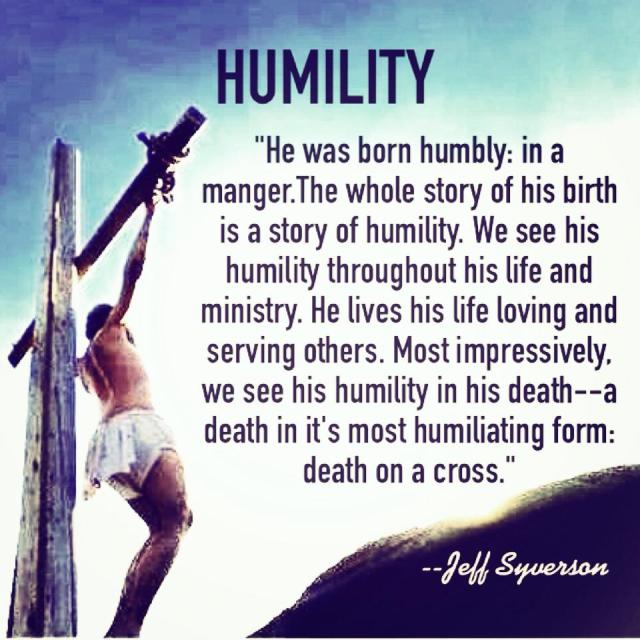
Paul encourages the Philippians to imitate Christ’s example of humility. What an example it is! Being in very nature God, he refused to grasp– to hold onto–his divine rights and willingly took on human flesh. In humility, God became man– and was born a babe in a manger. Imagine that, God in human flesh in the form of a helpless baby. He was born humbly: in a manger. His first visitors were humble shepherds. The whole story of his birth is a story of humility.

We see his humility throughout his life and ministry. He lives his life loving and serving others, “taking the very nature of a servant.” He takes the time to listen, to care, to bless, to help others. He lived his life, not looking to his own interests, but looking to the interests of others.

Most impressively, we see his humility in his death–a death in its most humiliating form: death on a cross. In this act of humility he demonstrates love to the highest degree.

In light of his example, we are encouraged to “be like-minded, having the same love, being one in spirit and purpose.” We should “do nothing out of selfish ambition or vain conceit.” Instead, “in humility, we should consider others better than ourselves.” It is not an easy example to follow, but he has promised to help us. As Paul reminds us, “we can do all things through Christ who strengthens us.”

Father, help me to have the mindset of Jesus —to live out of humility. Pour out your love into my heart, strengthen me by your Spirit so that I can indeed follow the example of Jesus. Amen.

Posted in Uncategorized | Leave a comment

Learning to Pray from Paul (Sept 29)

loveabounding

From Open Up Your Heart by Jeff Syverson

September 29

Learning to Pray from Paul

Today’s Scripture Readings: Psalms 107:10-16 | Isaiah 57:14-59:21 | Philippians 1:1-26 | Proverbs 24:9-10 

Today’s Scripture Focus: Philippians 1:1-26

And this is my prayer: that your love may abound more and more in knowledge and depth of insight, [10] so that you may be able to discern what is best and may be pure and blameless until the day of Christ, [11] filled with the fruit of righteousness that comes through Jesus Christ–to the glory and praise of God (Philippians 1:9-11 NIV). 

Do you ever pray the prayers of Paul? Let me encourage you to do that. Pray them for yourself, and everyone else on your prayer list. Pray them for your pastor and church. Almost every one of the epistles of Paul has at least one prayer. They are all gems. You can learn a lot about prayer through them.

We often focus on the immediate needs. Paul prays for the big things, the overarching things. Instead of a quick fix for the moment, Paul prays for that which will make the biggest impact in the big picture of things. Rather than focusing only on the present need, Paul’s prayers impact the here and now by focusing on the eternal. There is so much to learn from his prayers.

The prayer of Paul for the Philippians is a great starting place:

I pray that your love may abound more and more in knowledge and depth of insight so that you may be able to discern what is best and may be pure and blameless until the day of Christ, filled with the fruit of righteousness that comes through Jesus Christ—to the glory and praise of God (Philippians 1:9-11).

We all need a daily overflowing dose of God’s love. We all need the wisdom and discernment to not only know what is good, but even what is best. We all need Christ’s fruit of righteousness manifest in our lives that we would bring him praise and glory. We all need God’s grace and the Holy Spirit’s empowering if we are going to be pure and blameless until the coming of Christ. It’s a great prayer. 

Some time ago, I printed out the prayers of Paul and began making them a regular part of my prayer life. I applied them to myself, to my congregation, to others I knew. It had a powerful impact in my life. I encourage you to do the same.

Father, I pray that love would abound in knowledge and depth of insight more and more in my life and in my church so that we may be able to discern what is best and may be pure and blameless until the day of Christ. I pray that we will be filled with the fruit of righteousness that comes through Jesus Christ—to the praise and glory of God. Amen.

Posted in Uncategorized | Leave a comment

Joy in the House of Prayer (Sept 28)

joyinthop

Quote from Open Up Your Heart by Jeff Syverson

September 28

Joy in the House of Prayer

Today’s Scripture Readings: Psalms 107:1-9 | Isaiah 54:1-57:13 | Ephesians 6:1-24 | Proverbs 24:8 

Today’s Scripture Focus: Isaiah 54:1-57:13

“These I will bring to my holy mountain and give them joy in my house of prayer” (Isaiah 56:7 NIV).

Prayer should be a joyful experience. Whether personal times of prayer, or corporate times of prayer, those times should be characterized by joy. 

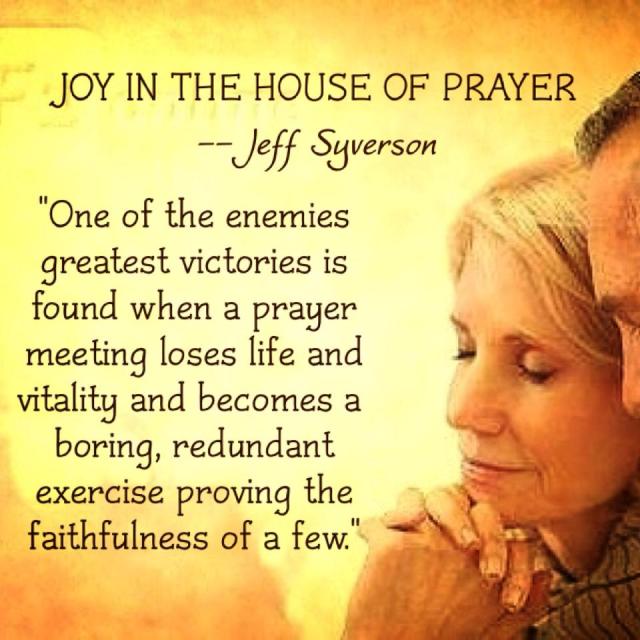
Yet often, our prayers lives and prayer meetings are sleepy and boring. They lack focus. Our words become mechanical, thoughtless and flippant. We pray in unbelief and accomplish little if anything at all. One of the enemy’s greatest victories is found when a prayer meeting loses life and vitality and becomes a boring, redundant exercise proving the faithfulness of a few.

There is joy in his presence (fullness of joy) and so when we connect to him in prayer, we can expect a surge of joy. When we pray together, we can expect that joy to be multiplied and to overflow.

Don’t allow your personal times of prayer to become redundant and boring. Try something fresh and new. Don’t get in a rut where you begin to pray mindlessly—and without any real faith.

When you pray with others, be careful not to drone on and on endlessly. Nothing drains the life out of a prayer meeting like a longwinded prayer, or praying exactly the same phrases each week predictably. People tune out. It’s not time to catch up on your personal devotions; it’s time to pray together. It is not a time to try to impress others with flowery sentences and archaic phrases. 

Learn to pray corporately instead of as individuals in a group. It helps to remember the “B’s” of corporate prayer:

Be brief, be bold (pray in faith), be biblical (pray the scriptures, claim the promises), Burden (pay attention to the burdens and insights the Holy Spirit gives), build on each other’s prayers, breakthrough (remain focused on thing at a time until you sense there is a breakthrough). 

Expect joy in your personal times with God. Come expecting to be a part of a joyful experience when you gather to pray. It is God’s intent to bring joy to your prayer gathering.

Father, in your presence is fullness of joy. Help me to be aware of your presence as I pray that I might find the joy that flows from being with you. Help me to bring that joy to others as we gather to pray. Strengthen me today with your joy. Amen.

Posted in Uncategorized | Leave a comment

Psalms, Hymns and Spiritual Songs (Sept 27)

PsalmsHymns3

September 27

Psalms, Hymns and Spiritual Songs

Today’s Scripture Reading: Psalms 106:40-48 | Isaiah 51:1-53:12 | Ephesians 5:1-33 | Proverbs 24:7 

Today’s Scripture Focus: Ephesians 5:1-33

“Be filled with the Spirit, speaking to one another in psalms and hymns and spiritual songs, singing and making melody with your heart to the Lord.” (Ephesians 5:18b-19 NIV)

One good indicator of a life lived in the fullness of the Spirit is a joyful, singing heart. When the Holy Spirit is really in control, he fills you with joy and he fills your heart with singing. Life lived in the flesh doesn’t produce joyful songs, but life in the Spirit always does.

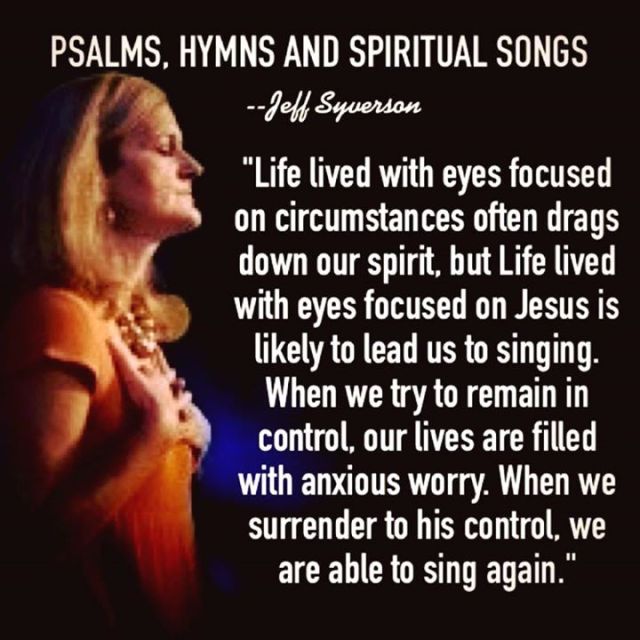
Life lived with eyes focused on circumstances often drags down our spirit, but life lived with eyes focused on Jesus is likely to lead us to singing.

When we try to remain in control, our lives are filled with anxious worry. When we surrender to his control, we are able to sing again.

What type of songs will you sing? “Psalms, hymns and spiritual songs.” In other words, sing all kinds of songs.

If a distinction is to be made between them, the psalms are heartfelt expressions covering nearly every circumstance of life and expressing nearly every emotion.  From lament to praise; from sorrow to joy; from times of feeling distant and alone to times of intimacy in his presence; From songs that celebrate God’s faithfulness in the past to songs that look for God’s justice in the future. Through the ages, the psalms have served as a prayerbook that teaches us to pray; a songbook that teaches us to praise.

Hymns certainly includes those well-thought out songs that express our theology. They bring depth to our worship and engage our mind to worship in truth.

Spiritual songs are often the simple, sometimes spontaneous songs, which flow from the Spirit. The best ones get passed on to others through worship songs. Simple, heartfelt and God-focused, they express our praise in our heart language. Spirit connects to spirit and song is birthed. We worship in spirit and in truth.

Be filled with the Spirit and sing; let your heart be filled with psalms, hymns and spiritual songs!

Lord, fill me with your Spirit anew and afresh, and fill my heart with singing. Amen.

Posted in Uncategorized | Leave a comment

I Have Not Forgotten You (Sept 26)

Ihavenotforgotten3

September 26

I Have Not Forgotten You

Today’s Scripture Readings: Psalm 106:32-39 | Isaiah 48:12-50:11 | Ephesians 4:17-32 | Proverbs 24:5-6

Today’s Scripture Focus: Isaiah 49

But Zion said, “The LORD has forsaken me; my Lord has forgotten me” (Isaiah 49:14 ESV).

Have you ever wondered if God had forgotten about you? Sometimes our prayers seem to go on unanswered for so long that we think he has forgotten us. Sometimes the circumstances of our lives are difficult and painful and we wonder how God could ever allow us to go through such a thing.

There are times that we wonder. There are times we may even say it: “The LORD has forsaken me; my Lord has forgotten me.” It may be a statement that is true to our feelings, but it is never really true. God never forgets his people. He never forsakes us.

Isaiah goes on to say: “Can a woman forget her nursing child, that she should have no compassion on the son of her womb? Even these may forget, yet I will not forget you. Behold I have engraved you on the palms of my hands” (49:15-16a).

How could a young mother forget her newborn baby? How could she fail to have compassion? God says that he will remember us and have compassion on us even more surely than a young mother who cares for her newborn child.

God may seem to hide for a time, but he has not forsaken you. He has not forgotten you. You are his child and he cares for you with the same loving affection given by a mother to her young child.

Father, thank you for being there and loving me even when I am unaware of your presence, even when I may feel that you have forgotten about me. In those times I can not feel  your presence, help me to rest in the truth that you are there and love me like a young mother who cares for her newborn child. Amen.

Posted in Uncategorized | Leave a comment

Thank You for Your Support! (Sept 25)

thanku3

September 25

Thank You for Your Support!

Today’s Scripture Readings: Psalm 106:24-31 | Isaiah 45:11-48:11 | Ephesians 4:1-16 | Proverbs 24:3-4

From him the whole body, joined and held together by every supporting ligament, grows and builds itself up in love, as each part does its work (Ephesians 4:16 NIV). 

We each have a vital role to play in the body of Christ. Each of us is gifted for ministry. The leadership gifts (like pastor-teacher) are given in large part to equip the body (all of us) to do the work of the ministry. We don’t sit in a pew and pay the pastor to do the work. The “up-front gifts” are given to equip those with the “behind the scenes gifts” to join those “up-front” in the work of ministry. Listen carefully to Paul: “It was he who gave some to be apostles, some to be prophets, some to be evangelists, and some to be pastors and teachers, [12] to prepare God’s people for works of service, so that the body of Christ may be built up [13] until we all reach unity in the faith and in the knowledge of the Son of God and become mature, attaining to the whole measure of the fullness of Christ” (Ephesians 4:11-13).

That is a beautiful picture of a healthy church. It is a picture of a church operating as it was intended to. Notice the results: the body is built up, there is unity, there is maturity, there is growth.

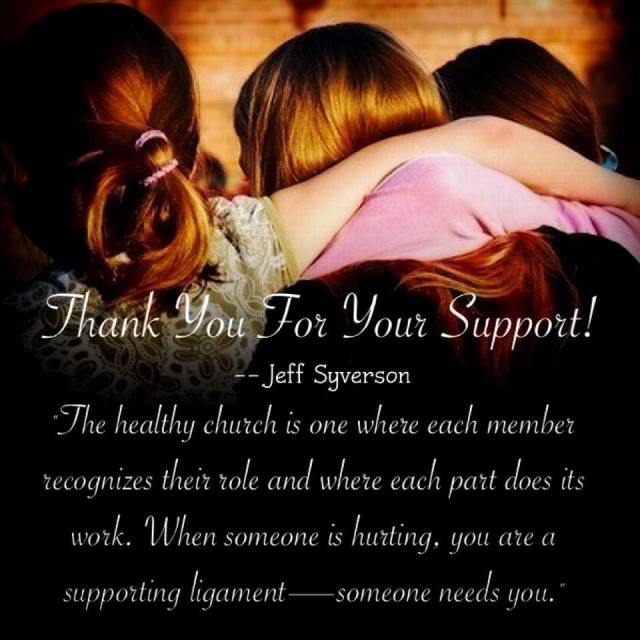
In addition to using our gifts in ministry, we are also to do our part in ministering to each other—caring for each other. Each of us is a supporting ligament in the body. Each of us has a part to play. When someone is hurting, you are a supporting ligament—someone needs you.

The healthy church is one where each member recognizes their role and where each part does its work. Imagine a body where only one arm was trying to do all the work. Little of value is accomplished. A healthy body requires a coordinated effort of all the parts. What is your part?

By the way, thanks for your support. I don’t know what I’d do without a supporting ligament like you!

Lord, help me to find my place and use my gifts in my local body of Christ. Help me to be an encouragement to others and support them in their time of need. Thank you for my brothers and sisters in Christ. Amen.

Posted in Uncategorized | Leave a comment

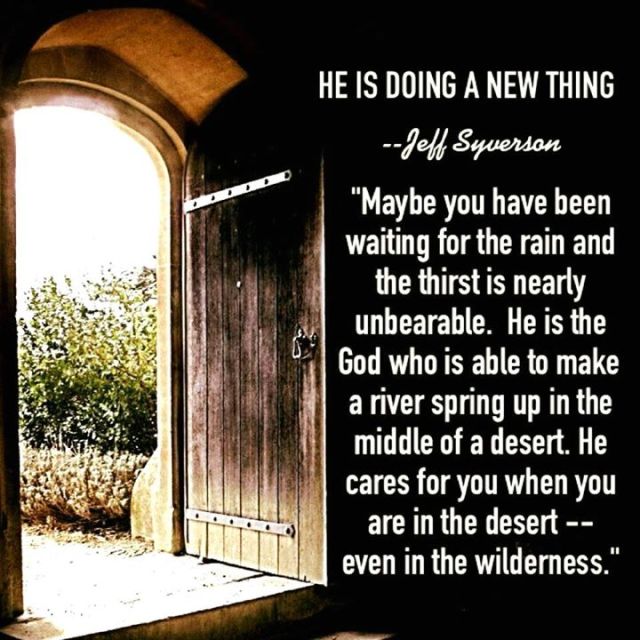
He is Doing a New Thing

Heisdoinganewthing3

September 24

He is Doing a New Thing

Today’s Scripture Readings: Psalms 106:13-23 | Isaiah 43:14 – 45:10 | Ephesians 3:1-21 | Proverbs 24:1-2

Today’s Scripture Focus: Isaiah 43-45

“Behold, I am doing a new thing; now it springs forth, do you not perceive it? I will make a way in the wilderness and rivers in the desert” (Isaiah 43:19 NIV).

Your situation is never hopeless with God. He is the God of new things.When there seems to be no hope, he opens a new opportunity.

He is the God who makes a way in the wilderness. In the wilderness you are tried and tested. You may feel alone and desperate. It may seem like you’ll be stuck in the wilderness forever. But God will not leave you there forever. When the time is right, he will make a way.

He is the God who is able to make a river spring up in the middle of a desert. Feeling dry and thirsty? In a moment, he can form a river in the most unlikely place.

He cares for you even in the desert–even in the wilderness. His purpose in all this is that you will sing him songs of praise. “For I give water in the wilderness, rivers in the desert, to give drink to my chosen people, the people whom I formed for myself that might declare my praise.”

Maybe you have been waiting for the rain and the thirst is nearly unbearable. Hear his words to you: “Fear not, for I will pour water on the thirsty land, and streams on the dry ground.” He hasn’t forgotten about you. The rains will come. He is about to do a new thing. Look for it.

Heavenly Father, open my eyes to all you are doing. When things seem stale, and I seem stuck, I look for you to do something new. When I am desperate and trapped, I need you to do something new. So God, work in my life in a fresh way today that I might drink from the springs of your goodness and that praise might spring up from within me. Amen.

Posted in Uncategorized | Leave a comment